
A 96.08% return figure tells you almost nothing about what will happen in the next ten minutes of play. That single statistic, quoted on every review site and lobby page, describes millions of spins averaged over time - not the wild swings a player actually experiences bet by bet. Anyone who has watched the wheel land on Coin Flip five times in a row, or seen a Crazy Time bonus round pay out forty times the stake, knows the gap between theory and lived experience is enormous.
This gap is exactly why understanding crazy time RTP matters more than memorizing a percentage. The number is a starting point, not a promise. Players who grasp how return to player interacts with volatility make better decisions about stake size, session length, and which segments of the wheel actually deserve their money. For a deeper technical breakdown of how the payout percentage is calculated and verified, the crazy time rtp explanation published by independent auditors offers useful context beyond marketing claims. From there, the practical question becomes how to translate that number into a workable strategy at the table.
What follows is a complete crazy time RTP guide built for players who want more than a headline figure. It covers how the percentage is calculated, why volatility reshapes the way that percentage feels in practice, how each betting segment differs, and what realistic expectations look like across a genuine session.
What RTP Actually Means in Crazy Time
Return to player is a theoretical figure calculated from the game's full mathematical model, not from any single session or player's results. It represents the percentage of all wagered money that the game is designed to pay back over an extremely large number of rounds - typically modeled in the millions. The remaining percentage constitutes the house edge, the built-in margin that makes the game commercially viable.
How the Percentage Is Calculated
Game studios build a probability model covering every wheel segment, every bonus game outcome, and every multiplier possibility, then run simulations to converge on a stable long-term average. The crazy time RTP percentage published for the base wheel sits around 96%, though this figure shifts depending on which bet type a player chooses, since each number and bonus segment carries its own distinct payout structure and probability.
Why RTP Is a Long-Term Average, Not a Short-Term Guarantee
A published RTP applies across a sample size no individual will ever personally reach. Across ten or even five hundred spins, actual returns can deviate sharply above or below the theoretical number. This is the central misunderstanding that trips up new players - treating a long-run mathematical average as if it predicts the outcome of the next round.
The Difference Between Theoretical and Actual Return
Theoretical RTP is fixed by design. Actual return, what a player walks away with after a session, is shaped by luck, timing, and the specific bets chosen. Two players wagering identical amounts over identical time can post wildly different results purely due to variance, even though both are playing under the same underlying crazy time slot return to player model.
Crazy Time RTP Volatility Explained
Volatility describes how returns are distributed - not how much comes back on average, but how unevenly it arrives. A low-volatility game pays smaller amounts frequently. A high-volatility game holds back for long stretches, then delivers disproportionately large payouts. Crazy Time sits firmly in the high-volatility category, and understanding this is arguably more useful than memorizing the RTP figure itself.
Why High Volatility Changes the Player Experience
The bonus rounds - Coin Flip, Cash Hunt, Pachinko, and Crazy Time - carry the bulk of the game's excitement and the bulk of its variance. Multipliers in these rounds can reach into the hundreds or even thousands, but they trigger infrequently relative to the four numbered segments on the wheel. This means most spins produce modest or no returns, punctuated occasionally by a result that reshapes an entire session's balance.
Volatility's Effect on Bankroll Swings
High crazy time RTP volatility translates directly into bankroll behavior. Expect extended stretches of gradual decline interrupted by sudden spikes. A disciplined bankroll - sized to absorb dozens of unremarkable rounds without forcing a player out of the game before a bonus round lands - matters more here than in low-volatility formats.
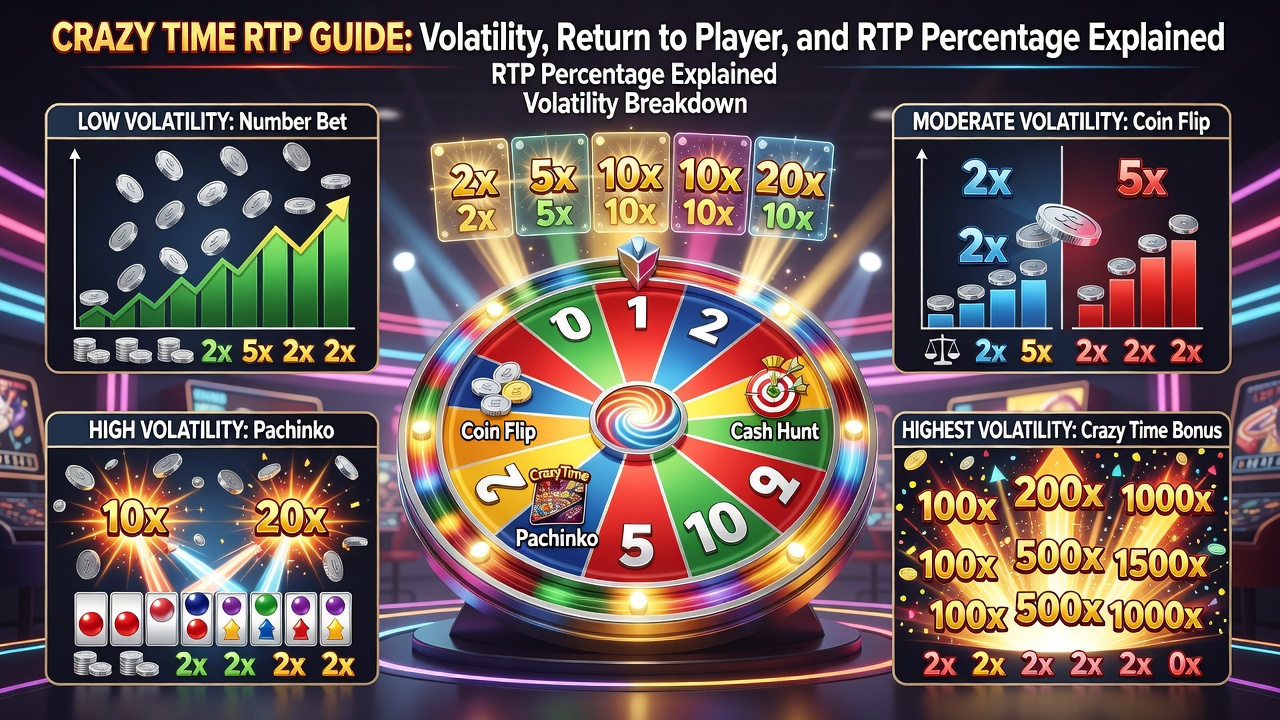
Comparing Volatility Across Bet Segments
Not every bet inside Crazy Time carries the same volatility profile:
- Number bets (1, 2, 5, 10) - lower volatility, frequent small wins, faster feedback loop
- Coin Flip - moderate volatility, capped multiplier ceiling relative to other bonus rounds
- Pachinko - higher volatility, occasional double-multiplier outcomes
- Cash Hunt - high volatility, multiplier spread depends on which of the hidden multipliers gets revealed
- Crazy Time bonus - highest volatility, largest multiplier ceiling, least frequent trigger
Breaking Down the Crazy Time RTP Percentage by Bet Type
The number quoted in official documentation is often an average across all betting options, which obscures meaningful differences between segments. A player betting exclusively on the number 1 experiences a different mathematical reality than one focused entirely on the Crazy Time bonus segment.
RTP for Number Bets
The numbered segments - 1, 2, 5, and 10 - pay out based on straightforward odds tied to how many of each number appear on the wheel. These bets tend to sit at the lower end of the RTP range for the game, generally in the low-to-mid 90s, reflecting their high frequency but modest payout ceiling.
RTP for the Four Bonus Games
Coin Flip, Cash Hunt, Pachinko, and Crazy Time each carry their own return figure, generally landing close to or slightly above the overall average, depending on the specific mechanics of the round and the multiplier possibilities embedded in it. The Crazy Time bonus round typically posts among the strongest theoretical returns, offset by its low trigger frequency and, in live formats, the added variable of the top-slot multiplier applied before the wheel is even spun.
How Top Slot Multipliers Influence Real Returns
Before each spin, a randomly generated top slot multiplier gets applied to one or two segments. When that multiplier lands on a segment a player has backed, the effective return for that specific round can spike dramatically above the theoretical baseline. This mechanic is part of why the crazy time slot return to player figure functions as an average rather than a fixed expectation for any single spin.
How Crazy Time RTP Compares to Other Live Casino Games
Placed alongside other live dealer formats, Crazy Time's RTP sits in a competitive but unremarkable range on paper. Where it distinguishes itself is in the shape of its volatility, not the size of its average return.
Crazy Time vs. Classic Roulette
European roulette typically returns close to 97.3% on standard bets, higher than Crazy Time's blended average. However, roulette's payout structure is far more predictable round to round, while Crazy Time's bonus mechanics introduce swings that roulette simply doesn't have.
Crazy Time vs. Other Wheel-Based Live Games
Compared to simpler wheel games with fewer bonus features, Crazy Time's RTP is broadly comparable, but its layered bonus rounds create a far wider distribution of possible outcomes. Simpler wheels tend toward lower volatility almost by design, since they lack the multiplier stacking mechanics that define Crazy Time.
Why RTP Alone Doesn't Determine Game Choice
A half-percentage-point difference in RTP matters far less than most players assume, particularly in a game this volatile. Session length, bankroll size, and personal tolerance for long dry spells should weigh more heavily in the decision than chasing the highest listed percentage.
Practical Ways to Use RTP and Volatility Data When Playing
Knowing the numbers only helps if they inform actual betting behavior. This is where a working crazy time RTP guide earns its keep - translating theory into decisions at the table.
Adjusting Bet Size to Volatility
Given the high-volatility nature of the bonus segments, smaller, more numerous bets tend to sustain a session longer than large bets concentrated on a single spin. This allows a bankroll to survive the inevitable stretches without a bonus trigger.
Balancing Number Bets and Bonus Bets
A mixed approach - spreading stakes across a couple of number bets alongside one bonus segment - smooths the variance somewhat, trading some upside potential for steadier, more frequent returns.
Setting Realistic Session Expectations
Given the mathematics involved, a single session is far more likely to reflect volatility than to reflect the published RTP. Treating short-term results as confirmation or contradiction of the RTP figure is a statistical error worth avoiding entirely.
Frequently Asked Questions
Does the RTP change based on how much I bet?
No. The theoretical return to player percentage is fixed by the game's underlying mathematics and does not shift based on stake size. Larger bets simply amplify the magnitude of both wins and losses, not the underlying probability.
Why did I lose several sessions in a row despite a high RTP figure?
This is a direct consequence of high volatility combined with a small sample size. The published percentage only becomes statistically meaningful across a very large number of rounds, far beyond what a typical session or even weeks of play will produce.
Which bet type offers the best RTP in Crazy Time?
The Crazy Time bonus segment often posts one of the stronger theoretical returns among all bet types, but it also carries the lowest trigger frequency and the highest volatility. Number bets offer steadier, more frequent but generally lower-percentage returns.
Do top slot multipliers affect the official RTP percentage?
Yes, they are factored into the overall calculation, since they occur on a defined frequency built into the game's model. Their randomness on any given spin, however, means individual rounds can deviate significantly from the average they contribute to.
Is Crazy Time riskier than traditional table games because of its volatility?
It carries a different risk profile rather than simply being riskier. Traditional games like standard roulette produce steadier, more predictable results, while Crazy Time trades that steadiness for the potential of much larger, less frequent payouts.
Can I predict when a bonus round or high multiplier will hit?
No mathematical model or pattern tracking can predict individual outcomes, since each spin is an independent random event. Streaks and dry spells are a normal feature of high volatility, not a signal of an upcoming change in results.