
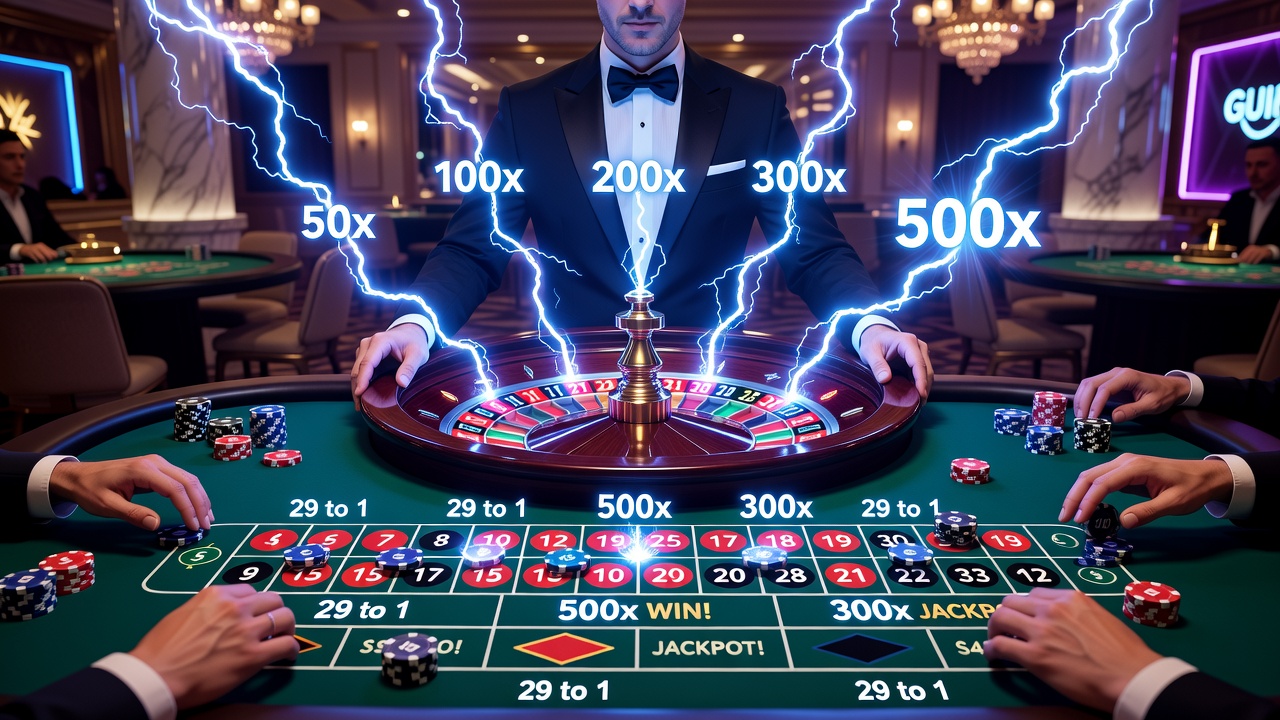
Five numbers on the wheel can pay up to 500 to 1 in a single spin. That single fact separates Lightning Roulette from every other roulette variant on the market and explains why it has become one of the most-played live dealer games in recent years. The mechanic is simple to describe but deceptively complex to play well: a random number generator strikes between one and five numbers with multipliers before each round, and if the ball lands on one of those "lucky numbers," the payout multiplies far beyond the standard 35 to 1 that straight bets normally return.
What makes this game worth studying rather than just playing on impulse is the tension between its raw excitement and its actual mathematical structure. Players who understand lightning roulette odds and how the multiplier system interacts with the house edge tend to make far better betting decisions than those chasing the next big multiplier blindly. Before placing real wagers, it's worth understanding how the platform presents the game and its rules - for instance, if you visit site you can see how the live tables are structured and what stake limits typically apply. That kind of preparation matters more in this game than in classic roulette, because the added multiplier layer changes how bankroll should be managed.
This guide breaks down the mechanics, the numbers behind them, and the practical decisions that separate informed players from those simply hoping for lightning to strike.
What Is Lightning Roulette and How Does It Work
The Core Game Mechanics
Lightning Roulette is built on a standard single-zero European roulette wheel with 37 pockets, but it adds a digital layer controlled by a random number generator (RNG) that operates independently of the physical wheel. Before betting closes each round, the RNG selects between one and five numbers and assigns each a multiplier ranging from 50x to 500x. These are the "lightning numbers" for that round.
How the Multiplier System Changes Betting
Once the lightning numbers are revealed, the dealer spins the wheel as normal. If the ball lands on a number that was not struck by lightning, straight-up bets pay the usual 29 to 1 (the standard European single number payout adjusted for this variant). If the ball lands on a struck number, anyone who bet on it straight-up receives the assigned multiplier instead. This dual-payout structure is the defining feature of the game and the reason lightning roulette strategy discussions almost always center on straight-up betting rather than outside bets.
Why This Differs From Classic Roulette
- Classic roulette pays a flat 35 to 1 on every straight-up win, with no variance in outcome value.
- Lightning Roulette introduces randomized high-value payouts that can reach 500 to 1, but only on struck numbers.
- The visual and audio presentation - lightning strikes, animated multipliers - is unique to this format and has no equivalent in traditional wheel games.
Lightning Roulette Strategy: Practical Approaches
Straight-Up Betting Focus
Because the multiplier system only applies to straight-up bets, most workable lightning roulette strategy approaches concentrate wagers on individual numbers rather than spreading chips across even-money or outside bets. Outside bets like red/black or odd/even are unaffected by the lightning multipliers entirely, so their appeal in this variant is purely about steadier, lower-variance play rather than chasing big wins.
Bankroll Allocation for High-Variance Play
Given that straight-up bets already carry low win probability in standard roulette, adding multiplier volatility means bankroll discipline matters more here than in most casino games. A common practical approach is to set aside a fixed session bankroll and divide it into small, equal units placed across multiple numbers per round, which increases the chance of hitting at least one lightning number without overcommitting to any single spin.
Balancing Coverage and Reward
Betting on more numbers increases the odds of hitting a lightning strike but dilutes the potential payout ratio relative to stake. Betting on fewer numbers concentrates risk but preserves the full reward if a lightning number hits. There's no universally "correct" balance - it depends on whether a player prioritizes frequency of small wins or the chance of a rare large one.
Avoiding Common Mistakes
- Chasing losses by increasing bet size after a non-lightning round rarely improves outcomes mathematically.
- Ignoring outside bets entirely removes a lower-risk option that can extend playtime.
- Assuming past lightning strikes influence future rounds - the RNG has no memory and each round is independent.
Lightning Roulette Odds Explained
Base Wheel Probability
The underlying wheel has 37 pockets, so any single straight-up number carries a 1 in 37 chance of hitting on a standard European roulette wheel, which translates to roughly 2.7% probability per spin. This baseline doesn't change in Lightning Roulette - the wheel itself is unaffected by the RNG-driven multipliers.
How Multipliers Affect Expected Value
The presence of lightning numbers alters expected value calculations for straight-up bets, but not uniformly. Since only up to five numbers per round receive multipliers, and the assignment is random, no player can predict which numbers will be struck before placing bets. This means the practical lightning roulette odds for hitting a multiplier on any specific number you've bet are lower than the odds of simply winning a standard straight-up bet, since you also need your number to be one of the ones struck by lightning.
House Edge Comparison
Standard European roulette carries a house edge of approximately 2.7%. Lightning Roulette's house edge varies by bet type because of the special payout structure on straight-up bets, and it is generally somewhat higher than classic roulette due to the reduced payout (29 to 1 instead of 35 to 1) on non-lightning straight-up wins, which offsets the occasional large multiplier payouts.
Lightning Roulette Payouts Breakdown
Standard Bet Payouts
Outside bets such as red/black, odd/even, and high/low pay the same as classic roulette: even money, or 1 to 1. Column and dozen bets pay 2 to 1, and other combination bets follow standard roulette payout tables unaffected by the lightning mechanic.
Straight-Up Payouts Without a Lightning Strike
When a player bets on a single number that is not struck by lightning during that round, the payout is reduced from the classic 35 to 1 down to 29 to 1. This adjustment exists specifically to help balance the added value of the multiplier system.
Straight-Up Payouts With a Lightning Strike
If the ball lands on a number that received a lightning multiplier, the payout jumps dramatically. Depending on the multiplier assigned by the RNG for that round, lightning roulette payouts on a struck number can be 50x, 100x, 200x, 300x, or as high as 500x the original stake. These figures apply per lightning number, and multiple numbers can carry different multipliers within the same round.
Real-World Payout Examples
- A $10 straight-up bet on a number not struck by lightning returns $290 total (29 to 1) if it wins.
- The same $10 bet on a number struck with a 100x multiplier returns $1,000 if it wins.
- A $10 bet on a number struck with the maximum 500x multiplier returns $5,000 if it wins.
Lightning Roulette Statistics and Data Patterns
Frequency of Lightning Strikes
Each round features between one and five lightning numbers, determined randomly before the wheel spins. Over a large sample of rounds, the distribution of how many numbers get struck tends to even out, though any individual session can see runs of low or high multiplier activity purely by chance.
Multiplier Distribution Trends
The RNG assigns multipliers with varying weight - lower multipliers like 50x and 100x appear more frequently than the rarer 500x maximum. This weighting keeps the overall lightning roulette statistics aligned with a sustainable house edge while still preserving the appeal of an occasional massive payout.
Using Statistics to Inform Play, Not Predict Outcomes
Tracking session history or reviewing published return-to-player figures can help players understand long-term expectations, but no statistical pattern allows accurate prediction of which numbers will be struck in a future round. Treating statistics as a guide to bankroll planning rather than a forecasting tool is the more defensible approach.
Live Lightning Roulette Rules You Need to Know
Table Setup and Betting Window
In the live dealer version, a real croupier spins a physical wheel while the lightning number generation happens digitally and is overlaid onto the live video feed. Players place bets during a fixed betting window, typically around 25 seconds, after which the lightning numbers are revealed before the wheel is spun.
Minimum and Maximum Bet Limits
Live lightning roulette rules typically set table limits similar to other live roulette variants, though the potential for high multiplier payouts sometimes leads operators to cap maximum win amounts per round. Players should check the specific table's rules screen before betting, since limits can differ between operators and stake levels.
Special Rules Around Lightning Numbers
Only straight-up bets are eligible for the multiplier bonus. If a lightning number is struck but no player has bet on it, the round simply proceeds as normal with regular payouts for winning bets elsewhere on the table. Lightning numbers are re-generated every round, so there is no carryover or accumulation between spins.
Dealer Interaction and Game Pacing
Because the game combines a live dealer with digital overlays, pacing tends to be brisker than classic live roulette, with the lightning number reveal adding a distinct dramatic beat before each spin. Understanding this rhythm helps players time their bets and avoid rushing decisions during the short betting window.
Frequently Asked Questions
Can I use basic roulette strategies like Martingale in Lightning Roulette?
Progressive betting systems like Martingale can technically be applied to outside bets, but they don't interact with the lightning multiplier system at all since those bonuses only apply to straight-up numbers. Using Martingale here mainly helps manage even-money bet sequences rather than improving your odds of hitting a lightning strike.
Is it better to bet on many numbers or just one or two?
Betting on more numbers increases your chance of covering a lightning strike but spreads your stake thinner and lowers the potential payout ratio on any single win. Betting on fewer numbers concentrates risk but preserves full multiplier value if you hit - the right choice depends on your tolerance for variance.
Do lightning numbers ever repeat in consecutive rounds?
Yes, since each round's lightning numbers are generated independently by the RNG, there's no rule preventing the same number from being struck in back-to-back rounds. Each generation is a fresh, random event with no memory of previous outcomes.
Why is the non-lightning straight-up payout lower than classic roulette?
The reduced 29 to 1 payout on non-struck straight-up bets helps offset the cost of occasionally paying out multipliers as high as 500x. This adjustment keeps the game's overall house edge sustainable for operators while still preserving the high-reward appeal for players.
What's the maximum I could theoretically win on a single spin?
The maximum comes from a straight-up bet on a number struck with the highest available multiplier, which can reach 500x your stake, though operators often apply an overall maximum win cap per round regardless of the multiplier achieved. Always check the specific table's rules for that cap before betting large amounts.
Does the live dealer version differ in odds from an RNG-only version?
The core wheel odds remain the same in both formats since they're based on the same 37-pocket European wheel structure. The main difference lies in pacing and presentation - live lightning roulette rules govern the physical dealer spin timing, while the lightning number generation itself is always digital regardless of format.